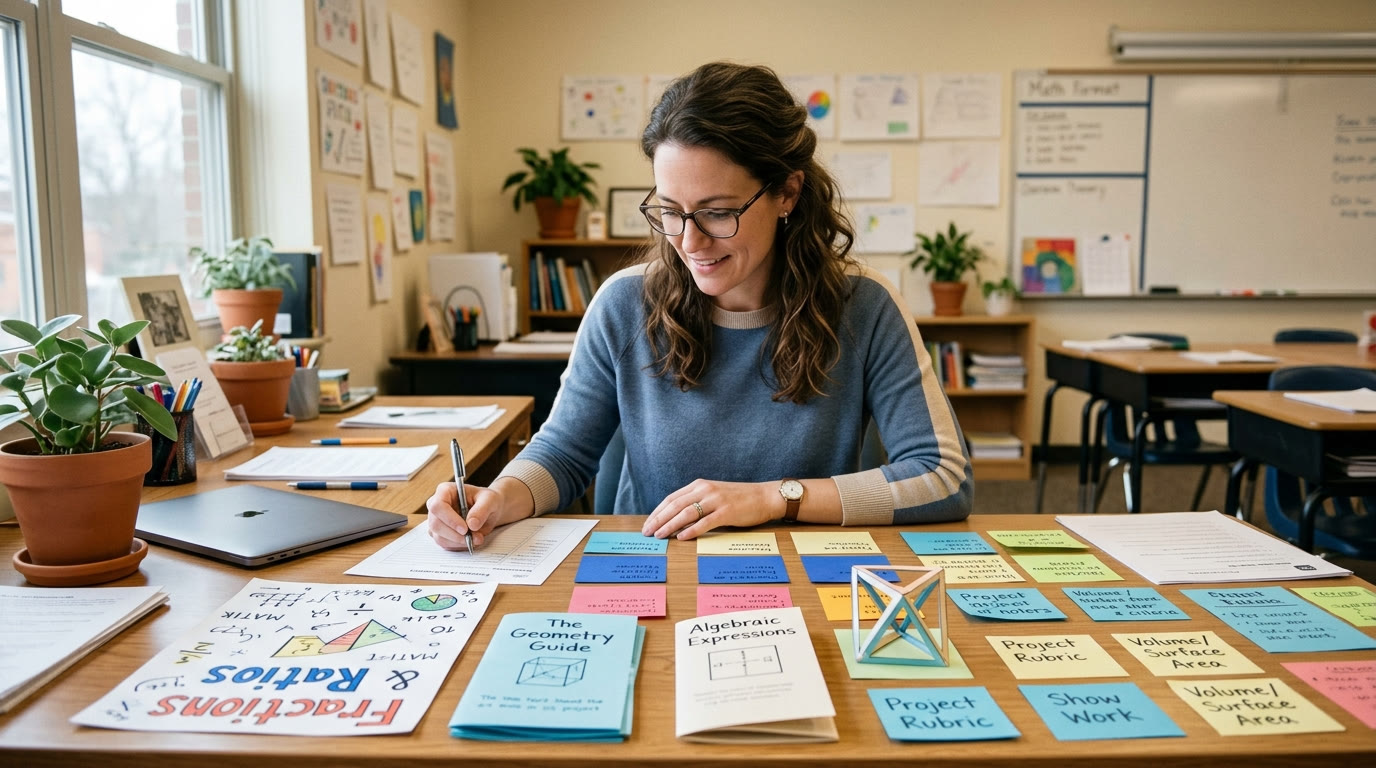
Formative assessment is the unseen work that makes summative assessment work. It's the daily checking, does this kid understand, or just nod along? AI can speed this up without replacing your judgment.
The problem it solves
You assign a worksheet. 28 kids turn it in. You have 30 minutes before the next class. You can't actually read all 28 deeply. So you:
- Spot check 5 of them (and hope the other 23 are fine)
- Skim for obvious wrong answers (and miss the subtle ones)
- Grade it fast and move on (and never actually diagnose the misconception)
Result: tomorrow's lesson is built on guesses about what they know.
What AI can do
AI can read all 28 quickly and tell you the patterns.
Step 1: Take a photo or scan of all the worksheets (or have them submitted digitally).
Step 2: Paste one student's work into an AI tool.
Step 3: Ask: "This student answered these questions. What do they understand about [topic]? What misconceptions do they have? If I could ask one follow-up question to clarify, what would it be?"
You get back something like:
"They understand that plants need light. They're confused about whether light provides energy or just visibility. They think photosynthesis might be just 'plants seeing.' Ask: 'Does a plant in a dark room use more energy or less energy than a plant in sunlight?'"
Now you know. This student doesn't need to redo the whole worksheet. They need one conversation about energy transfer.
How to scale it
Do this for every 5th worksheet, not every single one. The pattern you see from 5 kids tells you what the whole class struggled with.
Then, loop it back: reteach that one thing tomorrow. Give a new quick check. Ask the same AI question again. Better answers = learning happened.
For bigger assessments (end-of-unit test), ask the AI tool to group student responses by misconception type:
"These 28 students answered the synthesis question. Group their answers into categories: 1) Got the main idea, 2) Understand but wrong emphasis, 3) Wrong mechanism entirely, 4) Didn't attempt. How many in each group? What's the top misconception in group 3?"
Now you know: 18 kids are solid, 7 need reteach on mechanism, 3 need one-on-one. You can actually plan remediation that fits.
What AI can't do
- It can't replace your reading of the struggling student's work. AI gives you the pattern. You still need to talk to the kid and understand *why* they think that way.
- It can't make the judgment call. "Should this student move on or get more practice?" That's your call based on your knowledge of the kid, the stakes, and the next unit.
- It can't catch culturally specific answers. If a student's answer is right but uses logic from a different background, AI might flag it as wrong. You catch that.
The workflow
1. Student submits work (paper or digital).
2. You photograph or scan it.
3. Paste into an AI tool with a question: "What does this tell me about what this student understands? What's one thing I should check on?"
4. You read the response. Decide what it means.
5. Plan the next day based on patterns from 5 worksheets, not a deep read of all 28.
The [assessment blueprint tool](/assessment-blueprint) helps you design questions that surface thinking, not just right/wrong. And the [student feedback tool](/student-feedback) gives you templates for the actual follow-up conversation.