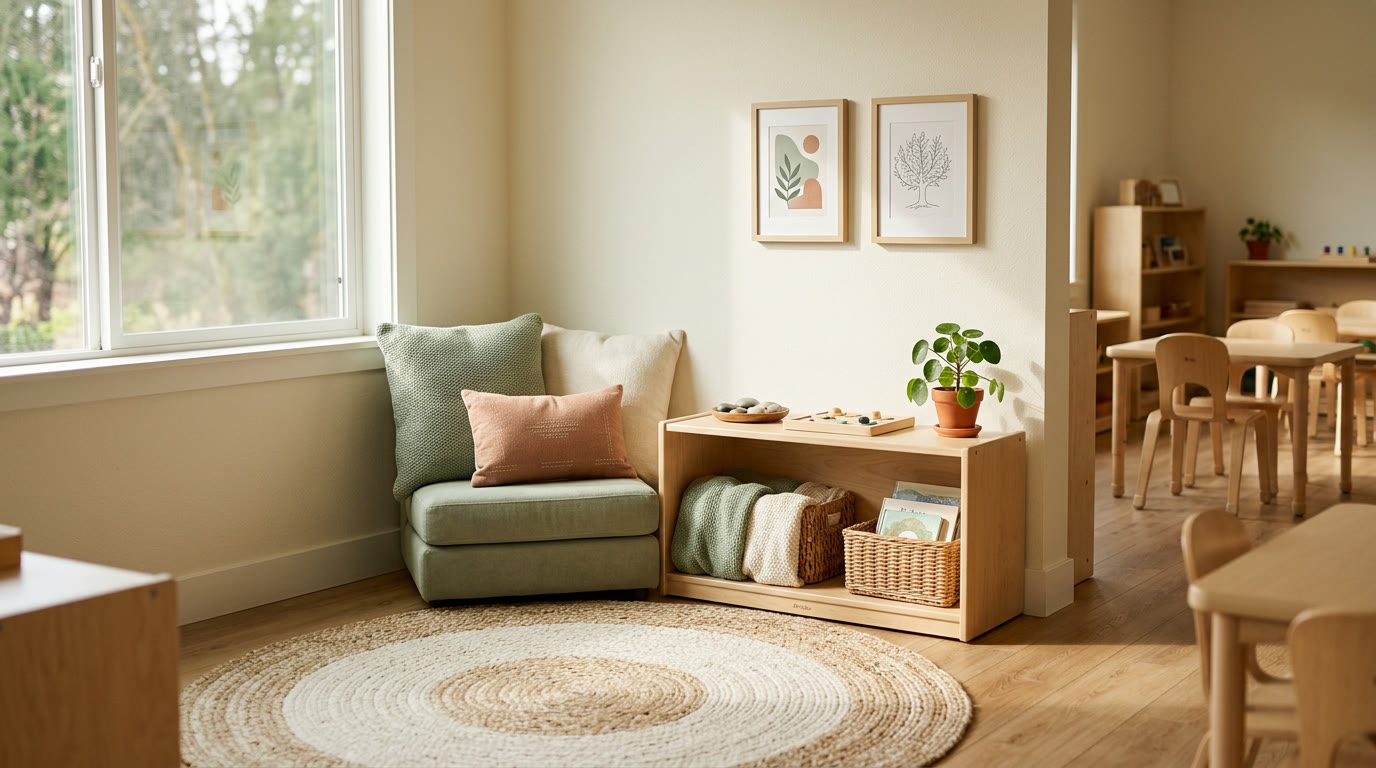
A calm-down corner shows up in almost every elementary classroom now — a beanbag, some visuals, maybe a sand timer. What's missing in most of them is a routine. Without one, the corner becomes either a reward for finishing work early or, just as often, an empty pillow nobody uses, because no student was ever actually taught what happens there.
The corner itself isn't the intervention. The routine around it is.
What the routine actually needs to answer
Before a student will use a calm-down space on their own, they need clear answers to a few concrete questions — not vague permission to "go calm down if you need to."
- How do they get there? A visual cue, a hand signal, or a card they can silently place on their desk — something that doesn't require raising a hand and announcing it to the room.
- What do they do once they're there? Two or three specific choices, taught and practiced ahead of time, not left to figure out in the moment (a breathing card, a fidget tool, a short visual timer).
- How do they know when to come back? A visible timer or a simple self-check card removes the guesswork of "how long is too long."
- What happens if it's not working? A clear next step — a check-in signal to you, or when it's time to involve a support staff member — decided ahead of time, not improvised mid-moment.
Teaching the routine before anyone needs it
The corner only works if every student has practiced using it when they're calm, the same way you'd practice a fire drill before an actual emergency. Model it, have the whole class try each option once, and revisit it explicitly after a break like a holiday week when routines tend to slip.
Try this:
- "I teach [grade level] and want to introduce a calm-down corner routine. Write a short, simple script I can use to model it for the whole class, plus 3 practice scenarios we can role-play together."
- "Generate a one-page visual routine card showing the steps: signal, choose a tool, use the timer, check in to return — using simple language a [age] student can read independently."
Our [classroom management tool](/classroom-management) can help you fold the calm-down routine into your broader set of classroom procedures so it's introduced alongside everything else in the first weeks, not bolted on later as an afterthought. And for a student whose self-regulation needs are already part of a formal plan, our [IEP goals tool](/iep-goals) can help you write a goal around independent use of a coping strategy that this exact routine supports.
What still needs your judgment
- Whether the corner is being used as intended. If it becomes a way to avoid work rather than regulate, that's a conversation, not a punishment — and a sign the routine needs re-teaching.
- Individual differences. Not every student regulates the same way; some need movement, not stillness. Build in more than one tool option rather than assuming one approach fits the whole class.
- When it's beyond a corner. A routine that isn't helping a specific student is useful information — bring it to whoever's already supporting that student's plan rather than assuming a classroom fix alone will solve it.