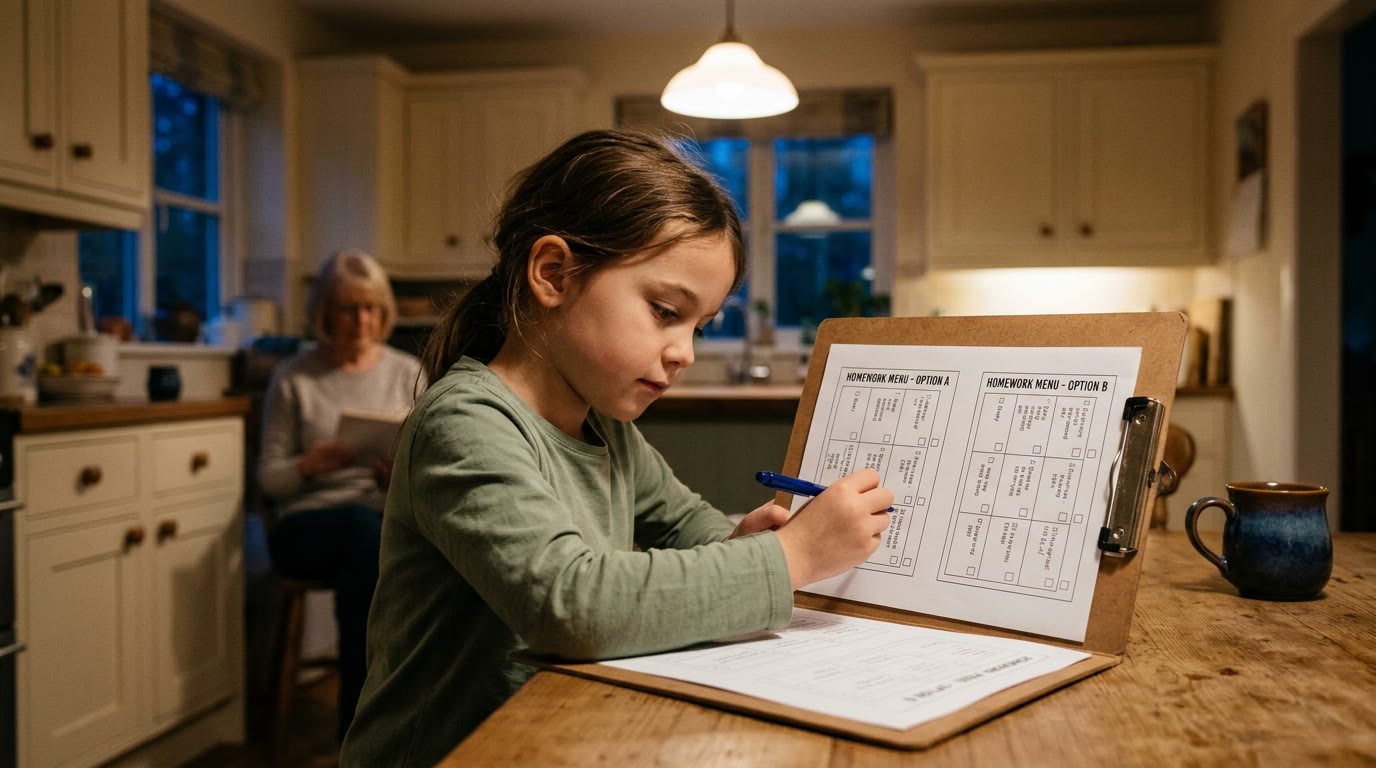
One homework sheet for the whole class is the easiest thing to hand out and one of the least useful things a struggling or advanced student can receive. Too easy and it's ten minutes of nothing; too hard and it's a battle at the kitchen table with a parent who doesn't know how to help either. A choice-based menu fixes this without you writing three separate assignments every single night.
Build the menu once, not nightly
The trick isn't differentiating homework every day — it's building a reusable menu structure for a skill and reusing the shape all unit long, only swapping the numbers or prompts inside it.
A menu that works has three lanes, not endless options:
- Practice. Straightforward reps at grade level — the "I've got this, just let me practice" lane.
- Build-up. A version with the same skill broken into smaller steps, or paired with a worked example, for students still shaky on the concept.
- Push. The same core skill applied to a harder or more open-ended problem, for students who'd finish the practice lane in five minutes and disengage.
Every lane targets the same skill. Nobody's doing a different topic; they're doing the same topic at a different entry point, which keeps grading simple and keeps the menu from feeling like a tracking label.
Getting AI to build the three lanes fast
Writing three versions of tonight's practice set by hand is the part that makes teachers quietly give up and just send one sheet. This is a fast, structured AI task once you hand over tonight's actual skill.
Try this:
- "Tonight's skill is [skill/standard]. Build three homework versions on this skill: a build-up version with a worked example and smaller steps, a straightforward practice version at grade level, and a push version with a harder or more open-ended application. Keep the same underlying skill across all three."
- "Here's my grade-level version: [paste it]. Write the build-up version with the same problems broken into guided steps, and the push version applying the same skill to a real-world or multi-step scenario."
Print all three, label them by color or letter instead of "easy/medium/hard," and let students pick — or assign quietly based on what you saw in class that day, without announcing which lane is which.
Keeping the choice from becoming a loophole
A menu only works if picking the easiest lane every night isn't actually the easiest path to a good grade. Grade for completion and effort on the menu itself, but keep your in-class checks — quizzes, exit tickets — tied to the actual grade-level skill, so a student can't coast on the build-up lane forever without it showing up somewhere that matters.
Our [differentiation plan generator](/differentiation-plan) can build this three-lane structure for a full unit at once rather than night by night, so you're not re-prompting for every homework set. And when a worksheet-based lane needs its own printable practice set, our [worksheet generator](/worksheet) handles the actual problem generation once you've got the lane structure decided.
What still needs your judgment
- Which lane a student needs tonight. The menu doesn't know who had a rough day in class — you do. Feel free to steer a student toward a lane even if they'd pick differently on their own.
- When one lane isn't enough. A student consistently landing in the build-up lane for weeks needs more than nightly homework differentiation — that's a signal for a bigger intervention conversation.
- How much to advertise the tiers. Keep the labeling neutral (colors, letters, shapes) rather than named difficulty levels visible to the whole class.