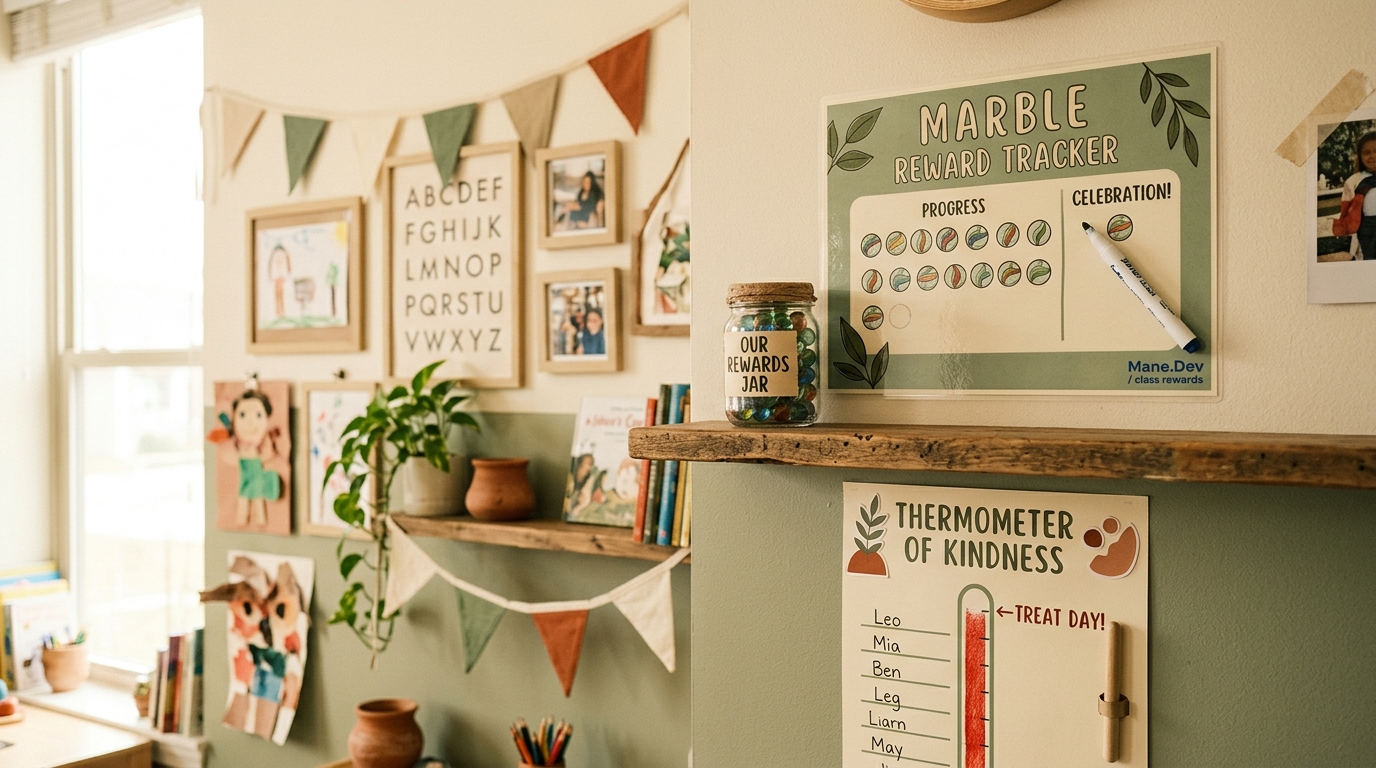
Every rewards system starts the same way: a burst of enthusiasm in the first two weeks, a chart on the wall, stickers or points or marbles in a jar. By November, half the class has stopped tracking it, the chart hasn't been updated in a week, and you're privately relieved nobody's asking about it anymore.
The system didn't fail because rewards don't work. It failed because most classroom rewards systems are built to be exciting on day one and are never built to survive being boring on day sixty - which is what every system eventually becomes, including the good ones.
Design for maintenance cost first, excitement second
Before picking what the reward *is*, decide how much time it costs you per day to run it. If tracking takes you five minutes of class time every single day, you will stop doing it by week six regardless of how motivating it is - not because you don't care, but because five daily minutes compounds into a real cost over a semester. The systems that last are the ones with near-zero daily upkeep:
- A single tally mark added during transition time, not a full point calculation
- A whole-class jar (one system to track, not thirty individual charts)
- A visual that updates itself - a fill-in thermometer or a jar of marbles - rather than a spreadsheet you have to open
Separate the "note it" moment from the "cash it in" moment
A lot of systems collapse because the reward is too far from the behavior. Kids (and teachers) lose the thread. Split the system into two simple pieces: a fast, frictionless way to mark the moment ("I noticed that" - a tally, a marble, a chip in a cup), and a separate, much less frequent moment where the marks convert into something real (a Friday choice-time, an extra five minutes of recess, a class shout-out). The marking has to be nearly instant or you won't do it consistently; the cashing-in can be rare, because rarity is part of what keeps it worth wanting.
Build in a reset that doesn't feel like punishment
The systems that die by December are usually the ones with no way to recover from a rough week. If the class "loses" all its progress after one bad Tuesday, the whole jar of goodwill built up since September evaporates, and kids (correctly) conclude the system is rigged against them. Build in a soft reset instead - marks never go backward, only forward, even in a slow week - so a bad day costs you nothing but a slower week, not a restart.
Let AI draft the structure, then simplify it once
A good use of AI here is asking for a first draft of the whole system, then cutting it down - the instinct on a first pass is almost always to over-design.
- "Design a whole-class rewards system for a [grade level] classroom. I want a low-maintenance way to mark good behavior in the moment and a monthly reward for reaching a threshold. Keep daily tracking to under 30 seconds."
Read the draft back and cut anything that requires you to remember a rule mid-lesson. If you can't explain the whole system to a substitute in two sentences, it's too complicated to survive your own actual Tuesday.
Where our tool fits
Our [classroom management plan generator](/classroom-management) builds routines - including reward and consequence structures - sized to your actual daily schedule rather than an idealized one, so what you get out is something you can realistically run past October, not just August.
The best rewards system isn't the most motivating one on paper. It's the one still taped to the wall, marked up, in June.