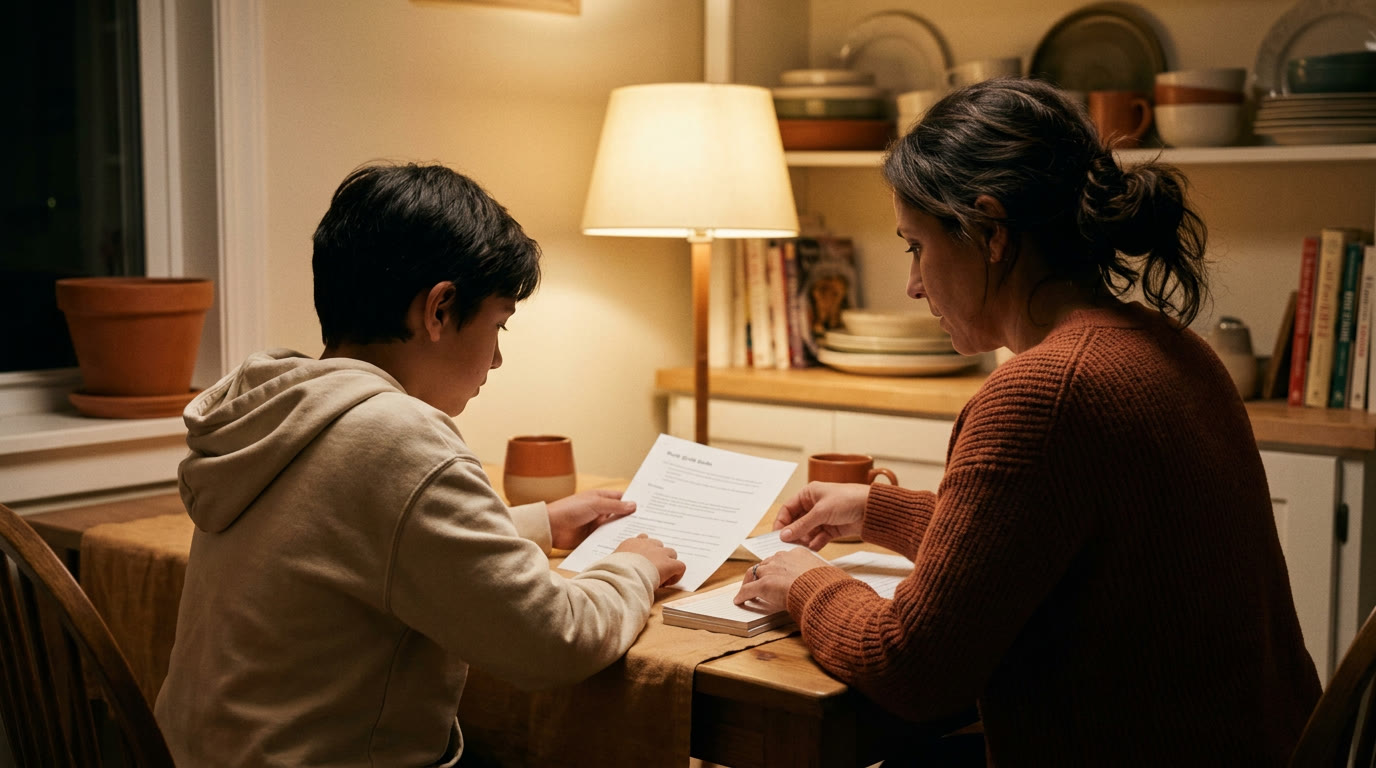
"How can I help at home?" is the question you get the week before a test. Handing families the same dense study guide students got in class often backfires. Parents who don't remember the unit either quiz too hard, teach a method you aren't using, or give up and hope the kid "looks it over."
A take-home guide for parent coaching is a different document. It assumes the adult is willing and content-rusty.
What parent-coachable actually means
The adult's job is to ask, listen, and check — not to re-teach the unit from scratch.
- Questions the parent can read aloud. "Explain how you know these fractions are equivalent using a picture or numbers." Not "Define equivalence in formal terms."
- A one-line "looks right when…" check. So the parent knows what a solid answer roughly includes without needing an answer key for every item.
- A worked example in student language. One model response parents can compare against, written the way you'd accept it in class.
- A 15-minute session shape. Warm-up ask → 3 practice prompts → one "teach it back to me" close. Parents can finish before dinner gets cold.
Build the guide in layers
1. List the 5 skills the test actually weighs (not every topic you covered).
2. For each skill, write one parent-facing question and one "looks right when" line.
3. Add one common mix-up in plain English ("students often flip the dividend and divisor here").
4. Attach 3 short practice items students already saw in class — familiarity lowers panic.
5. End with a 2-minute oral check: student teaches the parent the hardest skill in their own words.
Where AI helps
Don't ask the model to invent your unit. Paste the skills you already decided matter for this test, then ask only for the parent layer — the coaching language around those skills.
Paste your unit skills and ask for the parent layer specifically:
"Turn these 5 assessed skills into a parent-coaching study guide. For each skill: one read-aloud question, one 'looks right when' line, one common mix-up in plain English. Add a 15-minute session outline. Audience: adults who want to help but didn't take this class. Don't invent skills I didn't list: [paste]."
Then you align the language to your methods. If you teach dividing fractions with keep-change-flip, don't let the model introduce a different algorithm in the example.
Our [study guide creator](/study-guide) builds the student-facing backbone from your standards and skills so the take-home version stays tied to what you're actually testing. Our [quiz generator](/quiz-generator) can produce the short practice set that attaches to the guide, matched to the same skills, so parents aren't drilling random worksheet pages from the internet.
What still needs your judgment
- Method match. Parent help that teaches a conflicting procedure creates worse confusion than no help.
- Scope. Five skills. Not fifteen. A thin guide that gets used beats a thick one that doesn't.
- Equity. Not every home has a free adult for 15 minutes. Keep an in-class version of the same guide so no one's grade depends on home coaching.