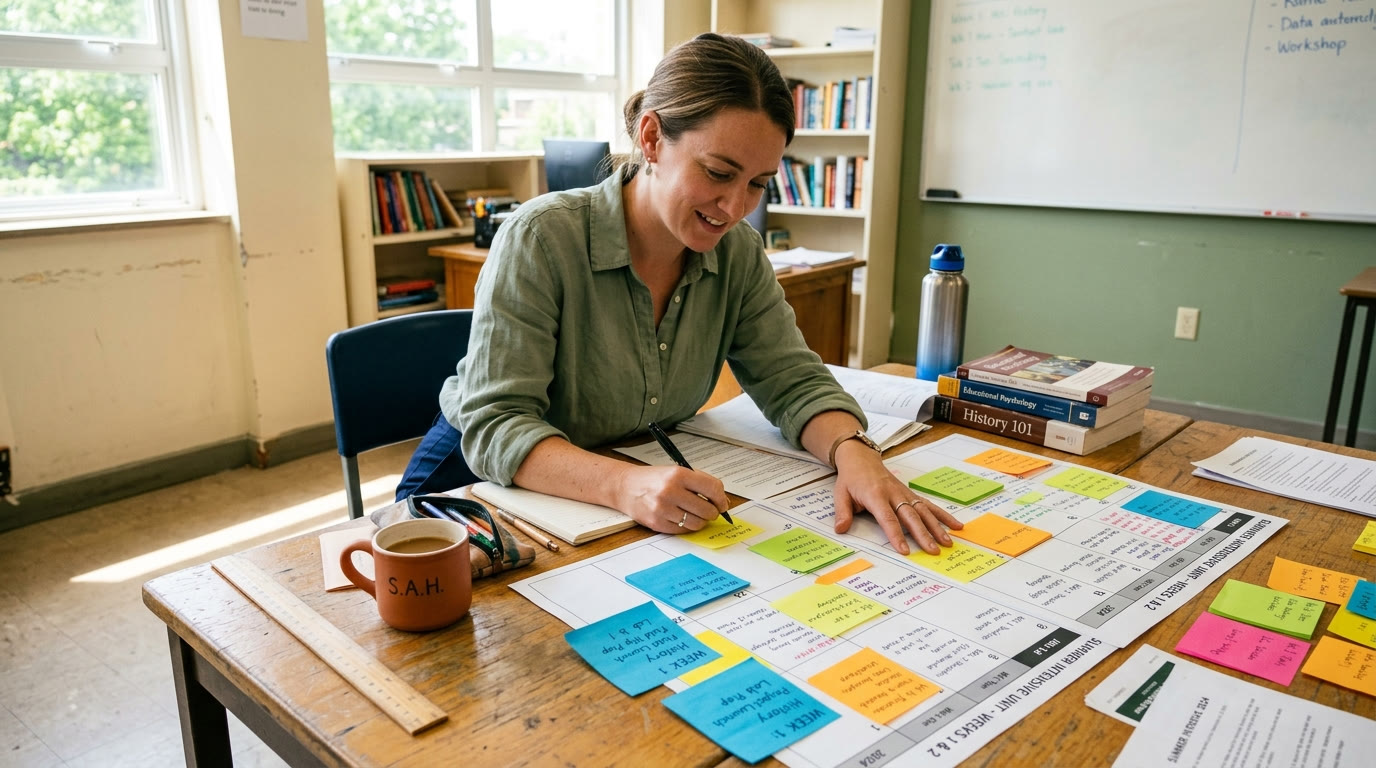
The first time I taught a summer intensive, I took my regular six-week unit and tried to squeeze it into two weeks by just moving faster through the same sequence of lessons. It didn't work. Speeding through the same eighteen steps in a third of the time doesn't compress a unit — it just means students experience each step as a blur, and the ones who needed a beat to catch up never get one.
A compressed unit needs a different shape, not the same shape running at 3x speed.
Decide what's load-bearing before you touch the calendar
Every regular-length unit has content that's essential to the final understanding, and content that's useful-but-cuttable — extension activities, a second worked example when one would do, a discussion day that's valuable but not structurally necessary. In an 18-week version you can afford both. In a 2-week version you can't.
Before planning a single day, sort your normal unit's content into two piles:
- Load-bearing — if a student misses this, the rest of the unit doesn't make sense
- Reinforcing — valuable, but the unit still holds together without it
Compress by cutting almost everything from the second pile, not by shortening everything from the first pile equally.
Build backwards from the final assessment, harder than usual
Backwards design matters in any unit, but it's non-negotiable in a compressed one, because there's no slack to discover halfway through that you're not actually building toward the final task. Start from exactly what students need to be able to do by day 10, and work back from there to figure out the minimum sequence of days that gets them there.
1. Write the final task or assessment first, in concrete terms
2. List the 3-4 specific skills a student needs to complete it
3. Assign each skill roughly 2-3 days, in the order they build on each other
4. Anything left over that doesn't map to one of those skills gets cut, not squeezed in
Build in a recovery day, even in two weeks
It feels counterintuitive to spend a full day of a 10-day unit on catch-up, but a compressed calendar has zero slack for absences, a lesson that runs long, or a concept that needs a second pass. Without a built-in recovery day, the first hiccup pushes everything else out and you end the unit having never reached the final task at all. Put one recovery/catch-up day around the midpoint, planned in advance, not improvised when you're already behind.
Where our tools fit
Our [unit plan generator](/unit-plan) can help you draft the backwards-mapped sequence once you've identified the load-bearing skills, and it's a faster way to iterate on day-by-day sequencing than building it from a blank calendar. If the intensive is built around a single final product rather than a traditional test, our [PBL unit tool](/pbl-unit) can help you structure the driving question and milestones so a two-week project stays on track without the usual slow-build runway a full-semester project gets.
A compressed unit isn't a smaller version of your regular unit — it's a different unit, built backwards from the same final understanding with everything non-essential already gone before day one.