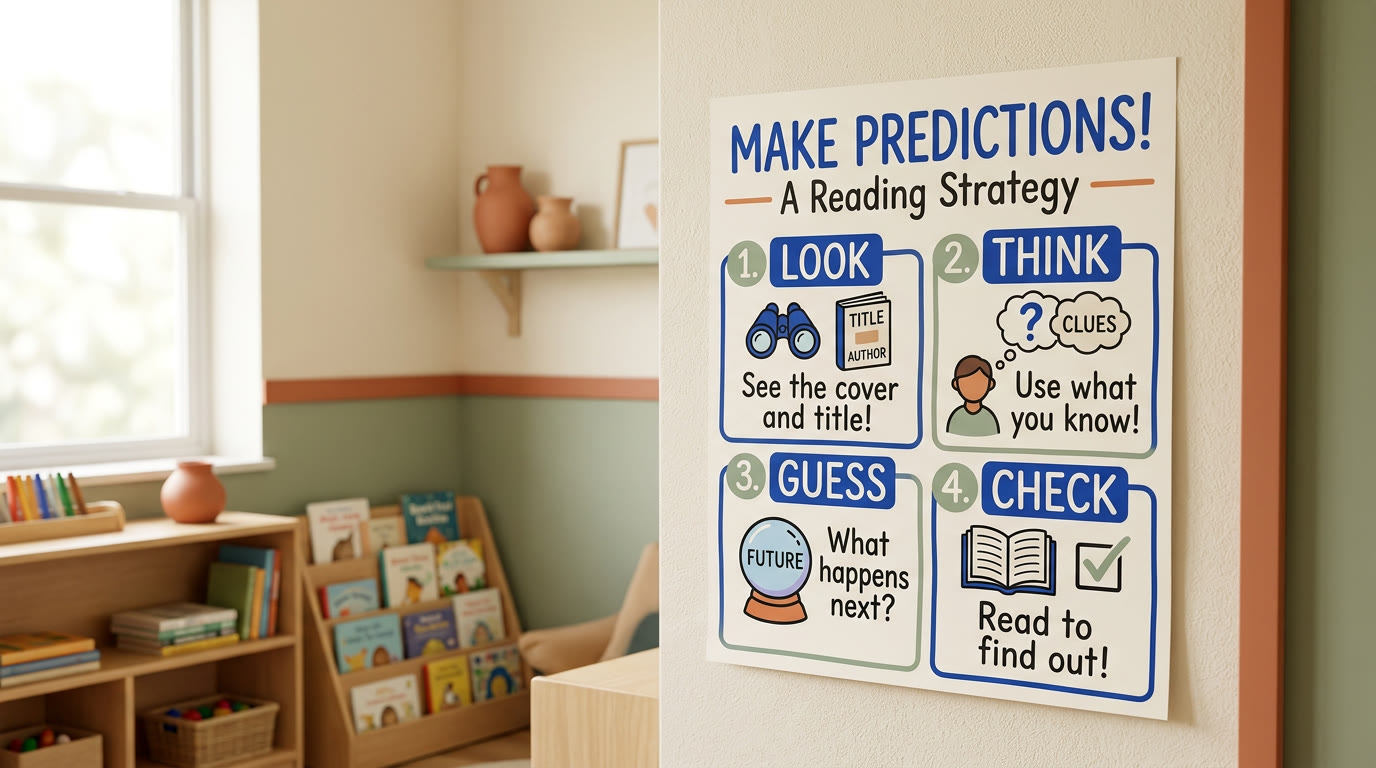
You spend real time making a good anchor chart — clean layout, the right amount of white space, language that actually explains the strategy instead of just naming it. Then it goes on the wall and serves maybe two-thirds of your class well. Your strongest readers reference it independently. Your struggling readers look at it, get lost somewhere around the second sentence of the third bullet, and quietly stop trying to use it, which defeats the entire point of an anchor chart: a resource students can use *without* asking you.
Making three separate versions from scratch is the obvious fix and also the reason most teachers don't do it — one good chart is already an hour of work, and tripling that isn't realistic on a Tuesday night.
The actual bottleneck isn't the design, it's the rewriting
The layout, icons, and color scheme can usually stay identical across all three versions — what changes is sentence length, vocabulary, and how much is implied versus spelled out. That's a rewriting task, and it's exactly the kind of task that's fast with the right prompt and slow by hand.
1. Write your best version first, at whatever level you'd naturally pitch it — this is your master copy and it stays as-is for on-level readers.
2. Ask an AI tool to rewrite it at a specific lower reading level, giving it constraints, not just "make it simpler": shorter sentences, one idea per bullet, concrete verbs instead of abstract ones, and no compound sentences. Vague requests get you a chart that's shorter but not actually easier to parse.
3. Ask for an extension version for your above-level readers — not a harder chart, but one with an added "why this works" layer or a more nuanced example, so your strongest readers get something to stretch toward instead of a chart they've outgrown.
4. Keep the visual layout consistent across all three so a student who moves between reading groups still recognizes the chart's shape and doesn't have to relearn where information lives.
Our [differentiation plan tool](/differentiation-plan) can help you generate the three reading-level variants from one core explanation, matched to actual grade-band language rather than a guess at what "simpler" means. And if you want a version students can keep at their desk instead of only referencing on the wall, our [worksheet generator](/worksheet) can turn the same leveled content into a personal reference sheet.
Where this actually gets used
A 4th grade teacher built a three-level anchor chart for "finding text evidence" — the on-level version used the full explanation with an example sentence; the below-level version cut it to three short steps with a sentence starter ("The text says __, which shows __"); the above-level version kept the steps but added a line about evaluating whether evidence is strong or weak. Same wall space, same colors, three actual access points, built from one written explanation instead of three separate drafts.
What still needs your judgment
- Reading level and comprehension level aren't identical — a student can decode the on-level chart fine but miss the concept; watch for that mismatch rather than assuming reading level tells you everything.
- Don't visually flag which version is the "easy" one. Keep the design identical enough that a student referencing the below-level chart isn't broadcasting it to the room — same colors, same icons, same wall placement in whatever grouping you use.
- Revisit the levels partway through the unit. A chart pitched right in week one can be too easy or too hard by week three as the class actually learns the skill — treat it as a living document, not a one-time print job.