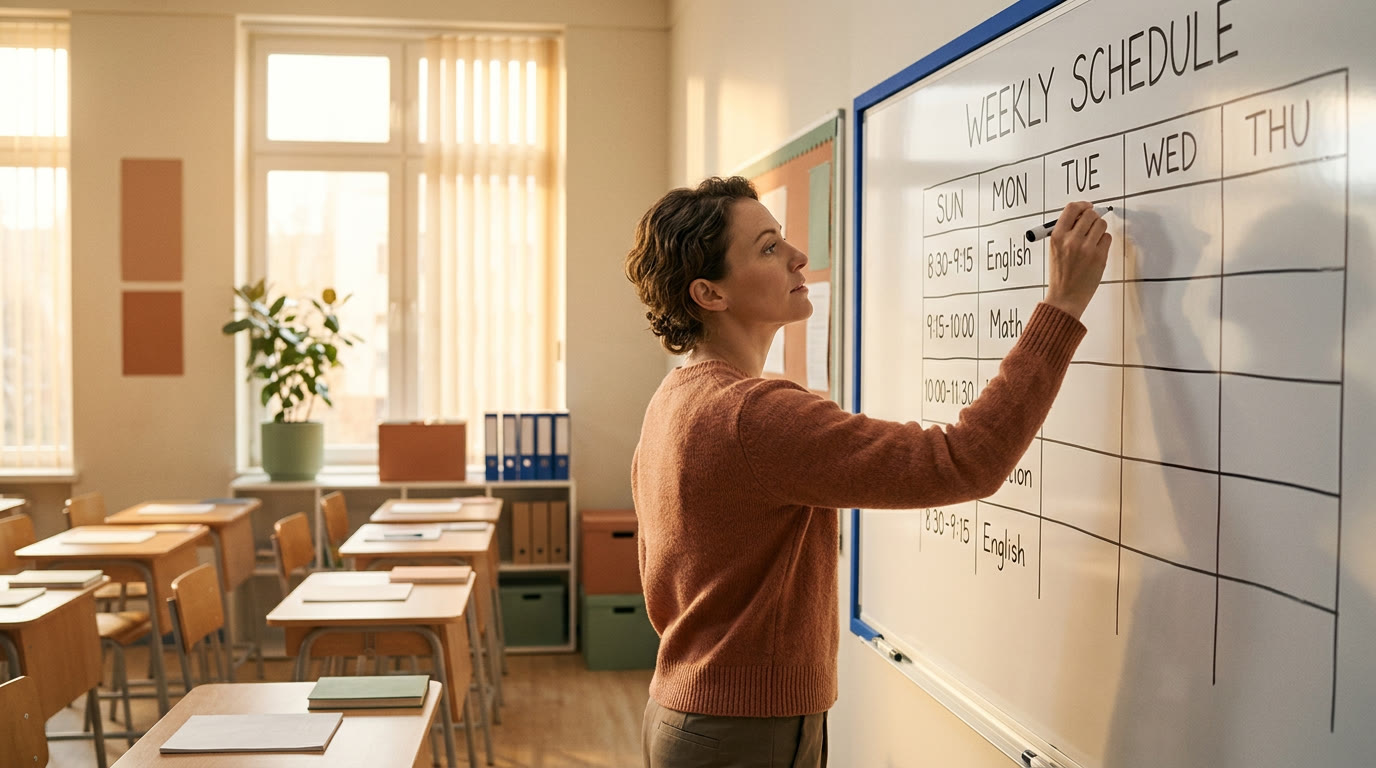
First-day plans get polished for weeks — the icebreaker, the syllabus walkthrough, the seating chart reveal. Day four is the day that actually breaks, because by then the novelty has worn off, students are testing which routines are real, and most teachers are improvising because all the planning energy went into day one.
Mapping the whole first week hour-by-hour, before the year starts, is what actually gets routines to stick.
Plan the routine you're teaching, not just the content
Every block in the first week is teaching two things at once: the subject and how this classroom runs. Split your planning into both columns so the routine doesn't get lost under the content.
- Monday: heavier on routine-teaching — how to enter the room, where materials live, what "start work" looks like. Light content.
- Tuesday-Wednesday: routines get a real workout under actual content, not just practiced in isolation. This is where day one's rules either hold or visibly don't.
- Thursday-Friday: the true test — do students run the routine without a reminder? This is where you find out what needs reteaching before it calcifies wrong for the rest of the year.
Build in a checkpoint, not just forward momentum
Most first-week plans move in one direction: introduce more each day. Build in a deliberate Thursday or Friday checkpoint where you name what's working and reteach what isn't, out loud, before it becomes the norm. "I noticed line-up is still taking three minutes. Let's practice it once, right now, until it's forty seconds." That five minutes in week one saves you from correcting the same thing in week six.
Use AI to draft the hour-by-hour scaffold, then adjust for your actual room
Bad prompt: "Give me first week of school lesson plans." Too generic, no connection to your routines or your content sequence.
Better: "I teach [subject/grade]. Here are the 3 routines I need students to own by Friday: [list, e.g. entering silently and starting a warm-up, turning in work in one place, group-work signal]. Build an hour-by-hour outline for Monday-Friday that introduces content at a normal pace while explicitly practicing these routines each day, with a checkpoint moment on Thursday to reteach whatever's slipping."
You'll still swap in your actual content and adjust timing once you see how your specific group moves through it, but the shell — where to build in the practice reps, when to checkpoint — comes out usable on the first pass.
Our [lesson plan generator](/lesson-plan-generator) can build the day-by-day content scaffold once you know your routines and sequence. Our [classroom management plan tool](/classroom-management) is the better starting point if you're still deciding which 3 routines matter most before you build the week around them.
What still needs your judgment
- Which routines actually matter. Three well-taught routines beat ten introduced and half-abandoned by Wednesday. Pick your non-negotiables before you plan the week, not during it.
- Reading the room. If Tuesday shows a routine isn't landing, adjust Wednesday's plan in real time rather than pushing forward on schedule.
- Content pacing. Don't sacrifice real content for routine-practice all week — by Friday, students should feel like they've actually started the subject, not just practiced procedures.