Every "STEM activity" you find online assumes a 3D printer, a robotics kit, or at minimum a supply closet nobody else is using. Most classrooms have none of that. What they do have is enough, a good STEM challenge was never really about the materials, it was about the constraint.
What actually makes an activity "STEM" and not just a craft
A lot of hands-on activities get labeled STEM because they involve building something, but building alone isn't the point. The activity needs three things a craft project skips:
- A real constraint that forces trade-offs. "Build a tower" isn't a constraint. "Build a tower that holds a tennis ball 30cm off the table using only 10 index cards and 20cm of tape" is, because now every choice costs something.
- A failure that teaches something. If the first attempt can't fail in an informative way, it's not engineering, it's assembly. The tower falling over should tell the student *why*, not just that it did.
- A second attempt built on the first. The redesign is the actual learning. An activity that ends after one build wastes the best part.
A materials list that fits any classroom
- Index cards, paper, or cardstock (nearly every classroom has some)
- Tape, the cheap kind, rationed by the inch, not the roll
- Paper clips, rubber bands, straws, whatever's in the junk drawer
- A stopwatch or timer on your phone
- Something to test against: a ball, a book, a set distance across the floor
None of this requires a supply order or a grant. The constraint does the work a fancy kit would otherwise do.
A structure that holds up for one period
1. Present the challenge with the constraint built in, not the materials list first. "Build X that does Y under Z limit" gives students something to solve, not just something to make.
2. Give 5 minutes for a plan on paper before anyone touches materials. This single step cuts the "grab everything and start taping" instinct that eats half the period.
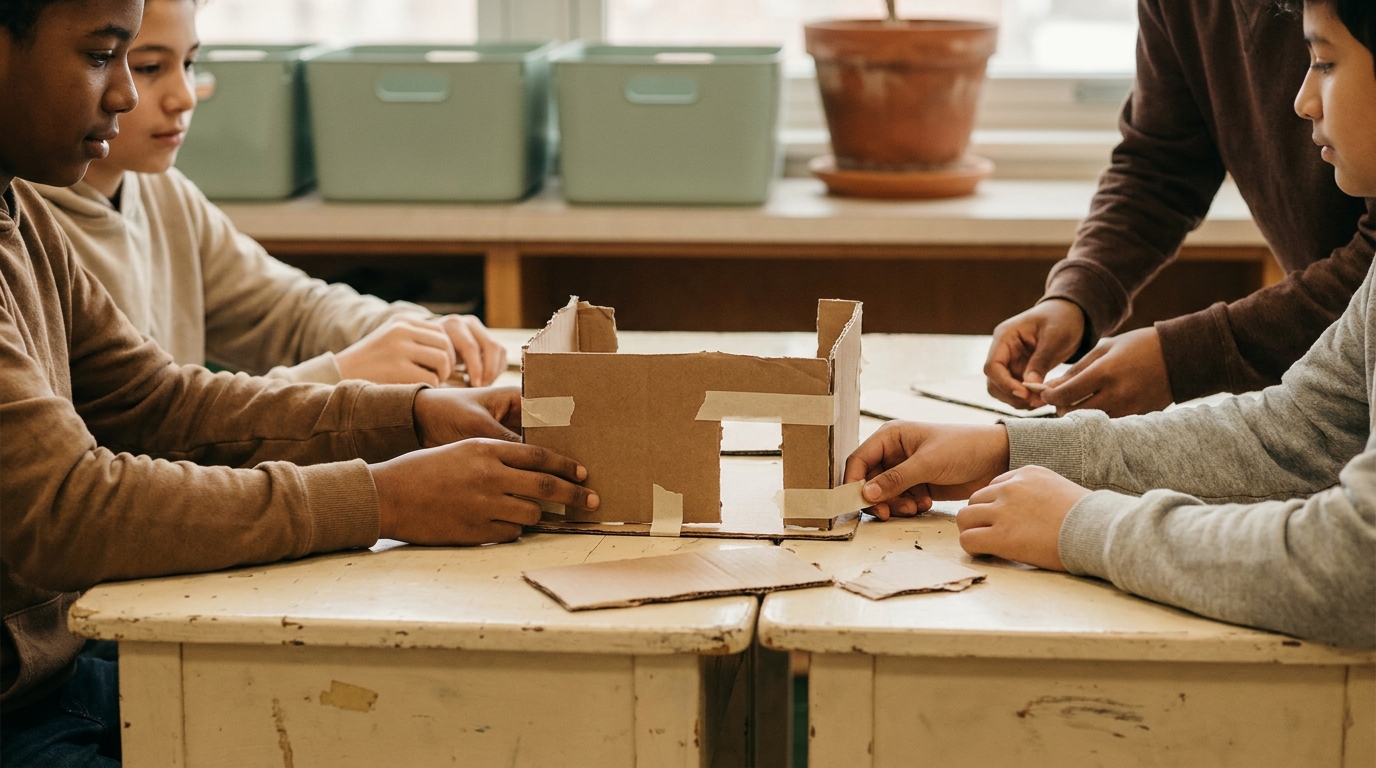
3. Build round one, test it, let it fail in front of everyone.
4. A short redesign conversation: what broke, why, what's changing. This is the part most rushed activities skip entirely.
5. Build round two, test again. The improvement, not the final product, is what you're actually assessing.
Where this gets easier to plan
Our [STEM/STEAM activity tool](/stem-activity) takes your topic, grade level, and real constraints (time, materials, space) and returns the challenge, materials list, procedure, and the underlying science or engineering concept spelled out, so you're not reverse-engineering a Pinterest photo to figure out what's actually being taught. It pairs well with a [project-based learning unit](/pbl-unit) when the activity is the anchor for something longer than one period.
The question to ask before you post the challenge on the board
"What happens if this fails on the first try, and does that failure teach the concept, or just frustrate the group?" If the honest answer is frustration, the constraint needs adjusting before the period starts, not after three groups have already given up.
The test of a STEM activity worth repeating next year
Ask whether a student could explain, without you prompting them, why their second attempt was different from their first. If they can point to a specific trade-off they made and why, the constraint did its job. If they just built a better-looking version of the same thing, the activity was a craft with extra steps.