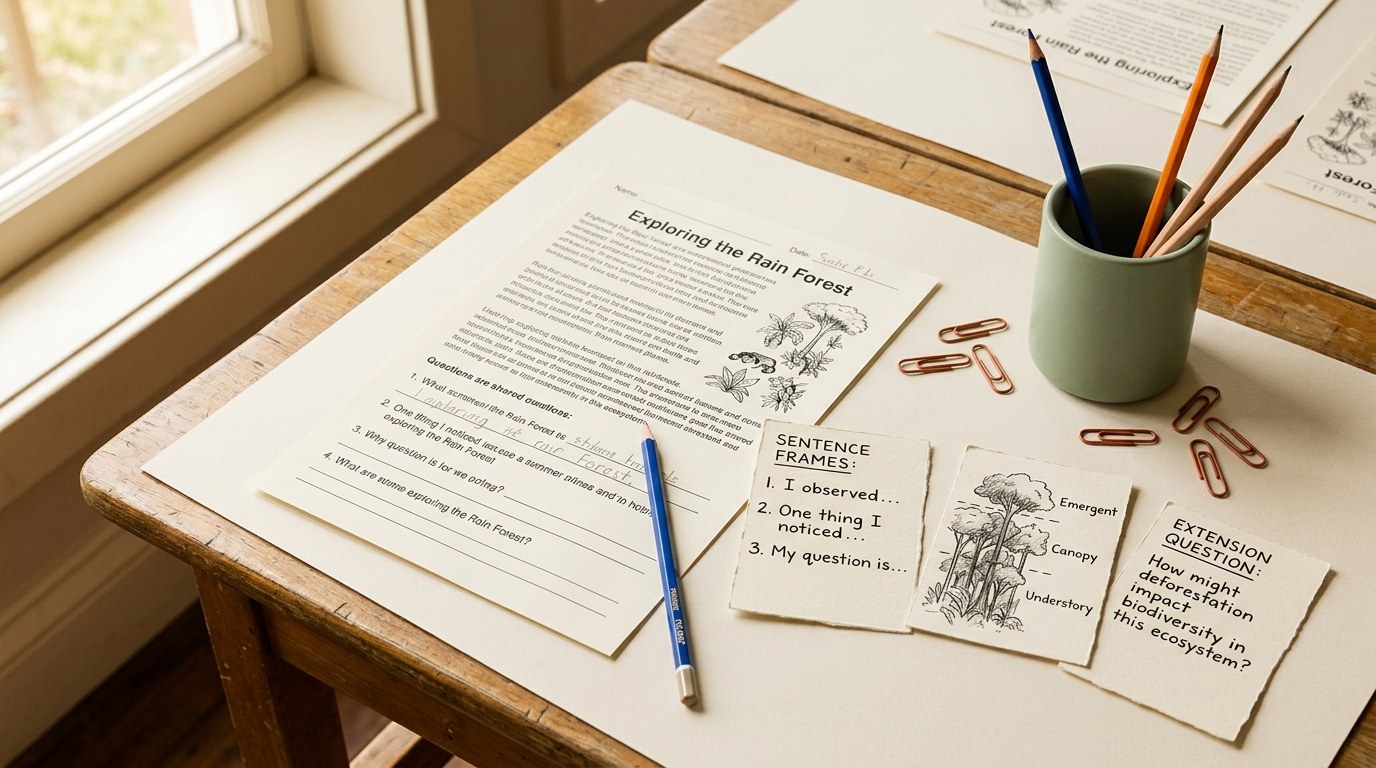
Differentiation isn't three lesson plans. It's one lesson with the right moves at the right moments. AI is genuinely useful for generating those moves, the small scaffolds, sentence frames, and extension prompts you don't have time to write from scratch.
Ask for the moves, not the plan
Bad: "Differentiate this lesson for ELLs and gifted students." You'll get a paragraph of platitudes.
Good: "For this activity [paste], give me: (1) two sentence frames an ELL newcomer could use to participate, (2) one visual support I could sketch on the board in 30 seconds, (3) one extension question for students who finish early that still ties to the objective. Keep everything on-topic, no rabbit holes."
Where it works best
- Sentence frames and word banks. Fast, accurate, easy to edit.
- Tiered questions. Give the model your one core question and ask for a scaffolded version and a stretch version.
- Exit ticket variants. Two versions with different numbers or names, same rigor.
Where to keep your judgment
- IEP accommodations are legal documents. The model can suggest ideas; you match them against the actual IEP.
- Cultural relevance requires knowing your kids. Don't outsource that to a model that has never met them.