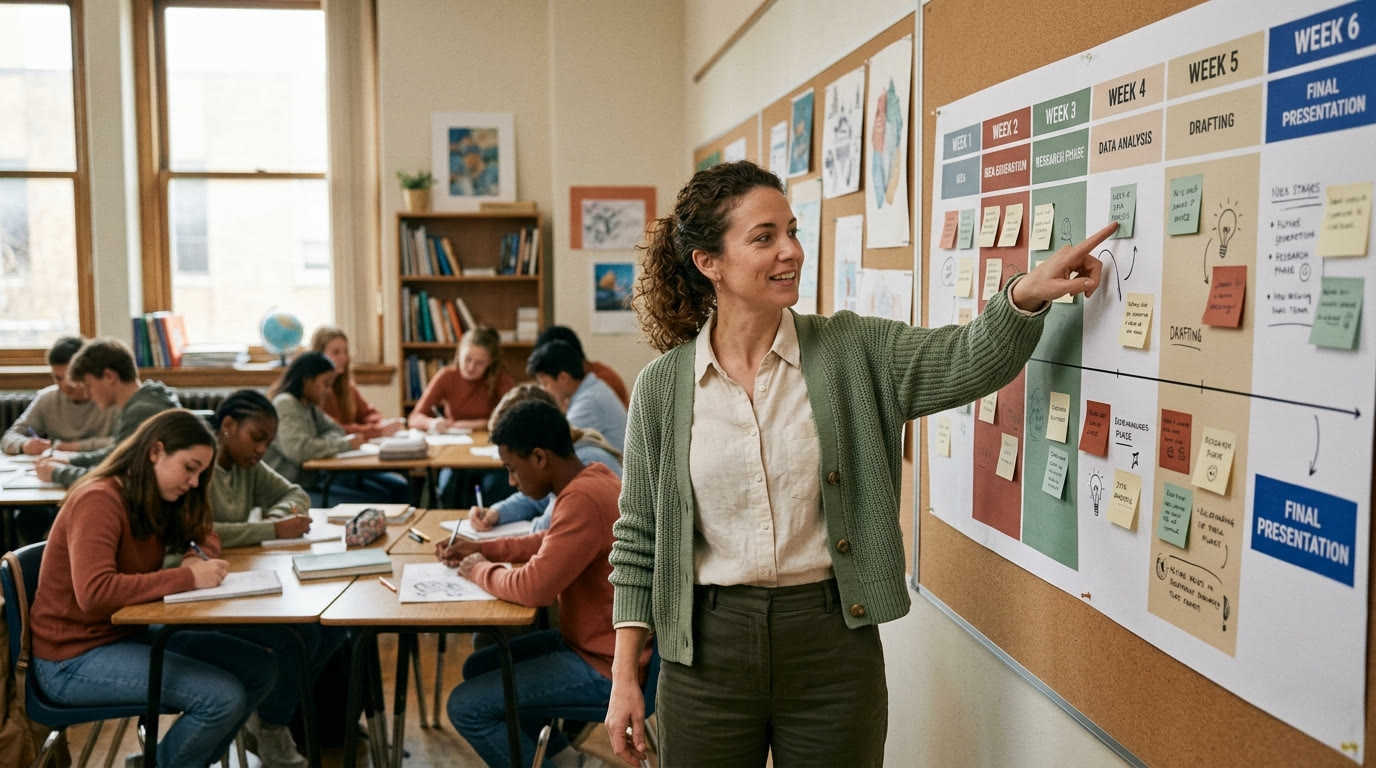
You assign a four-week project with one due date at the end. For three and a half weeks, most students do nothing - not because they're lazy, but because a single distant deadline doesn't create any pressure until it's suddenly close. Then the last 48 hours become a scramble, the work quality drops, and you spend the following week fielding "can I have one more day" emails.
The fix isn't a stricter deadline. It's a sequence of smaller ones that make the work visible before it's due, not just after.
Why one due date guarantees a collapse
A single end date gives students exactly one moment of accountability. Everything before that moment is optional in practice, even if it isn't on paper, because nothing checks in on it. Students without strong independent planning skills - which is most students, at most ages - will use all the slack you give them, then run out of time. That's not a motivation problem, it's a structure problem, and it's fixable with structure.
Build backward from the due date, not forward from day one
Start at the final deadline and work backward, placing a checkpoint everywhere a piece of work needs to exist before the next phase can start:
1. Topic or angle locked in. Usually by the end of week one - if this slips, everything after it slips too.
2. Research or source-gathering checkpoint. A specific number of sources or a rough outline due, not just "keep working."
3. Rough draft or first full pass. This is the checkpoint that catches the students who are behind while there's still time to recover, instead of finding out at the final submission.
4. Peer or teacher feedback point. Built into the timeline, not squeezed in if there's time.
5. Final polish and submission. The smallest chunk of remaining work, because everything substantial already happened earlier.
Make each checkpoint low-stakes but non-optional
A checkpoint that's worth a large grade turns into its own high-pressure event. A checkpoint that's worth a small completion grade, or just a "show me what you have" conversation, keeps the pressure low while still creating the accountability that makes students actually do the work on schedule.
- Weight checkpoints small (5-10% each) rather than treating them like mini-finals
- Make the checkpoint itself quick to check - a one-paragraph status update, not a full submission you have to grade deeply
- Follow up specifically with students who miss a checkpoint, before the gap compounds into a missed final deadline
Use AI to build the backward-mapped calendar
Turning a project scope and a due date into a realistic sequence of checkpoints is exactly the kind of structuring task AI handles well, especially when you give it your actual constraints instead of a generic timeline.
Try this:
- "I'm assigning a research project due in four weeks, [grade level], [subject]. Build a backward-mapped checkpoint calendar with 4-5 milestones between now and the due date, noting what's due at each one and roughly how much class time each phase needs."
- Adjust for your actual calendar - testing weeks, a field trip, a shortened week around a holiday - things the model won't know unless you tell it.
Where our tool fits
Our [project-based learning unit generator](/pbl-unit) builds the driving question and milestone structure together, so the checkpoints come out of the same planning pass as the project itself instead of being bolted on afterward. If you're mapping a broader unit rather than a single project, our [unit plan generator](/unit-plan) handles the same backward-sequencing logic across a full unit's worth of lessons.
A project that's actually finished in stages, not crammed into the last 48 hours, isn't just less stressful for students - it's the version where you can actually catch a problem while there's still time to fix it.