STEM stations fail in the first five minutes more often than in the experiment itself. Kids arrive, hover, and wait for you to explain Station 3 while Station 1 is already off-task. You become the bottleneck. The "independent" rotation was never independent.
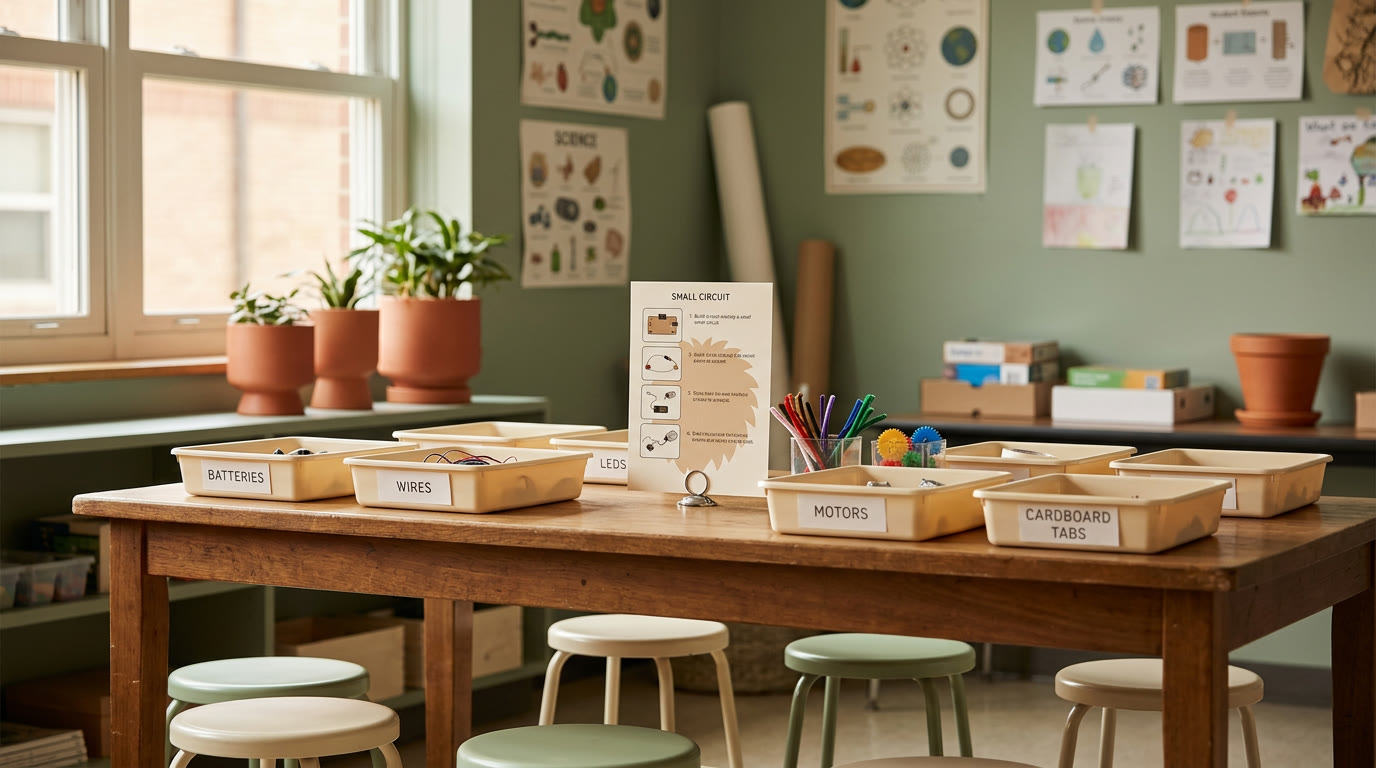
The fix is boring and powerful: every station must be startable from a card, a materials tray, and one worked example — without hearing your voice first.
What "startable without you" actually requires
- A one-goal card. One sentence: what success looks like at this station today. Not a paragraph of theory.
- Materials pre-counted. If they have to hunt for tape, you've already lost the opener.
- A tiny worked example or photo of a finished-enough product. Kids copy structure before they innovate. That's fine for minute one.
- A "stuck?" line on the card. Two options max: ask your partner the question on the card, or flip to the hint on the back. Not "raise your hand and wait."
If a station still needs a live demo every time, it isn't a station yet. Teach that skill whole-class once, then station-ize it.
A setup checklist you can reuse
1. Write the goal in student language ("Build a bridge that holds 10 washers for 10 seconds").
2. Put every material in one tray or bin labeled with the station number.
3. Add a 20-second example photo or sketch.
4. Add one common-mistake hint on the back of the card.
5. Time yourself: can a competent student start in under 60 seconds with you silent? If not, simplify the card.
What the first week of stations should look like
Day one, you still circulate — not to re-explain every card, but to watch where the card language fails. If three groups ask the same clarifying question, the card is wrong, not the kids. Rewrite that line overnight. By day three, your job during the opener should be almost invisible: a nod at the door, then attention on the one station with real safety risk.
That shift is the whole point. Stations aren't a furniture arrangement. They're a bet that clear written directions plus ready materials beat another round of whole-class instructions nobody remembers by Station 2.
Where AI helps without designing bad science
Use it to draft the cards and the stuck-hints from your actual activity goals. You still own safety, accuracy, and whether the challenge is real.
Try:
"Turn this STEM activity into 4 station cards. For each: one-sentence goal, materials list for 3 students, 60-second start instructions, one worked-example description, and one backside hint for the most common stuck point. Activity: [paste]. Grade: [X]. Constraints: no open flames, 12 minutes per station."
Cut anything cute. Keep anything clear.
Our [STEM / STEAM activity planner](/stem-activity) helps you shape the full activity before you slice it into stations, so the science goal stays coherent across rotations. Our [classroom management tool](/classroom-management) is useful when you're writing the rotation norms and the "what to do when stuck" routine that keeps hands down and brains on the card.
What still needs your judgment
- Safety. Cards don't replace your eye on heat, chemicals, or tools.
- Which stations need a live demo the first day. Some do. Demo once, then require the card forever after.
- Group roles. Stations get louder when nobody owns materials or cleanup. Assign roles on the card if your room needs that structure.