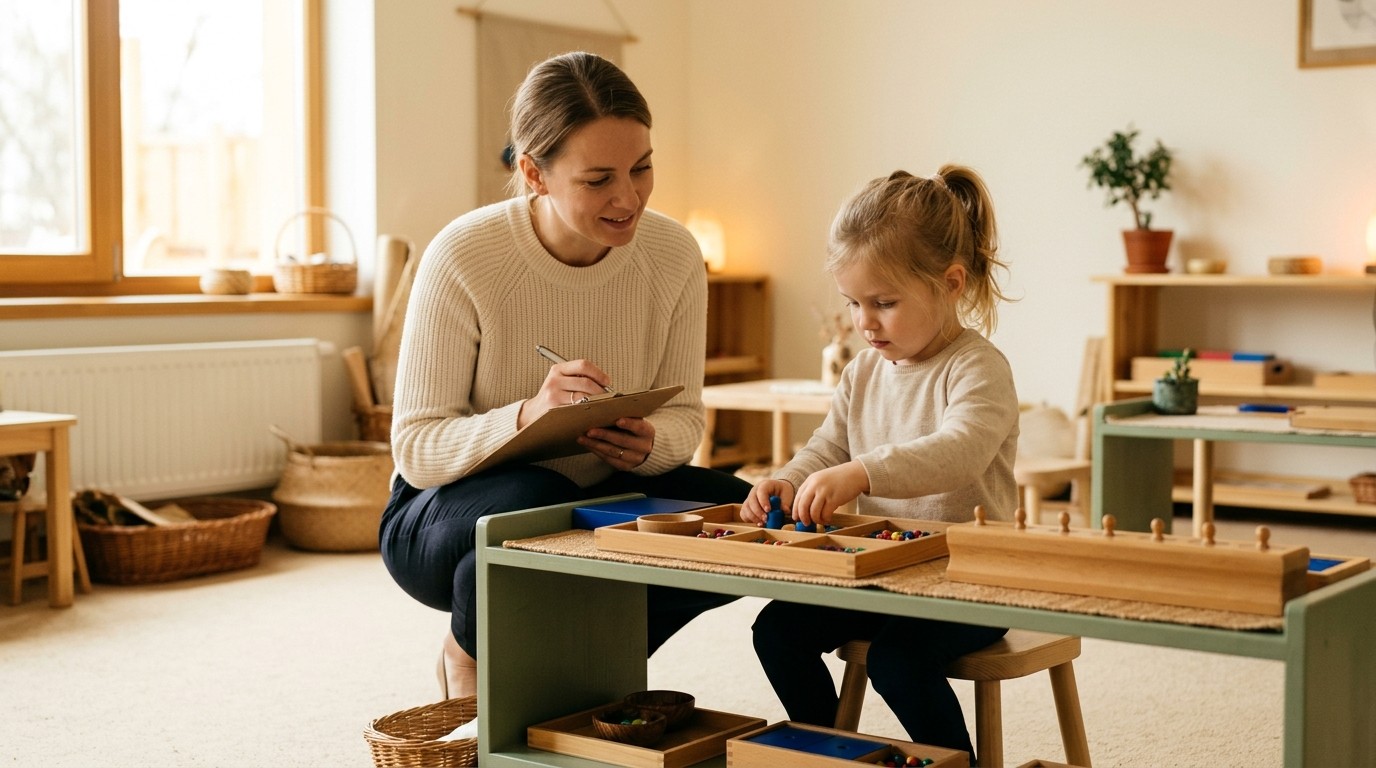
Most classroom observation notes end up in a binder nobody reopens. Real Montessori-style observation isn't about compiling a record for its own sake, it's a loop: watch closely, notice what the child is actually working on and where they get stuck, then change what you put on the shelf tomorrow. Skip the last step and the observation was just watching.
What makes an observation actually useful
A good observation note answers a narrower question than "how did the child do." It answers: what did this child choose, how long did they stay with it, where did the work break down, and what does that tell me to offer next. That last part is the piece most notes leave out.
What to actually record
- What they chose and for how long. Choice reveals interest and readiness in a way an assigned task never does. A child who returns to the same material for the third day running is telling you something about where they are.
- The exact point where the work broke down, not just "struggled with it." "Could count to nine correctly, hesitated and recounted from one at ten" is a usable note. "Struggled with counting" tells you nothing you can act on tomorrow.
- What independence looked like. Did they get materials out and put them away without a prompt, did they ask for help, did they redirect themselves when distracted. This is often more diagnostic than the academic content.
- The next material or variation to offer, decided while it's fresh, not three days later when you've observed six other children and forgotten the specifics.
A structure that keeps the loop closing
1. Child, date, activity chosen.
2. What happened, in neutral, specific language (not "did well" or "struggled").
3. The exact point of ease or breakdown.
4. One concrete next step: a new material, a variation, a repeat with one added challenge.
Where this gets easier to keep up with
Our [Montessori observation tool](/montessori-observation) is built around that same loop, so the note format itself forces you to land on a next step instead of stopping at description. And when the next step is genuinely a different path for one child versus the rest of the group, our [differentiation without three separate lessons](/differentiation-plan) tool turns that single observation into an adjusted plan without you rebuilding the whole lesson from scratch.
Why "just watch more" isn't the actual fix
Teachers who feel behind on observation often respond by trying to watch every child every day, which just produces more unusable notes faster. The real fix isn't more observation time, it's a tighter question. Instead of "how is this child doing," ask "what did this specific child's hands do today, and what does that tell me to change." A narrower question, asked of two or three children a day on rotation, produces more usable next-steps than a broad scan of the whole room that never gets past description.
The test of an observation worth keeping
Read the note back and ask whether it tells you exactly what to put in front of this child tomorrow. If the answer is a specific material or variation, the observation did its job. If the note only tells you how the child felt or generally performed, it's a diary entry, not an instructional tool yet.