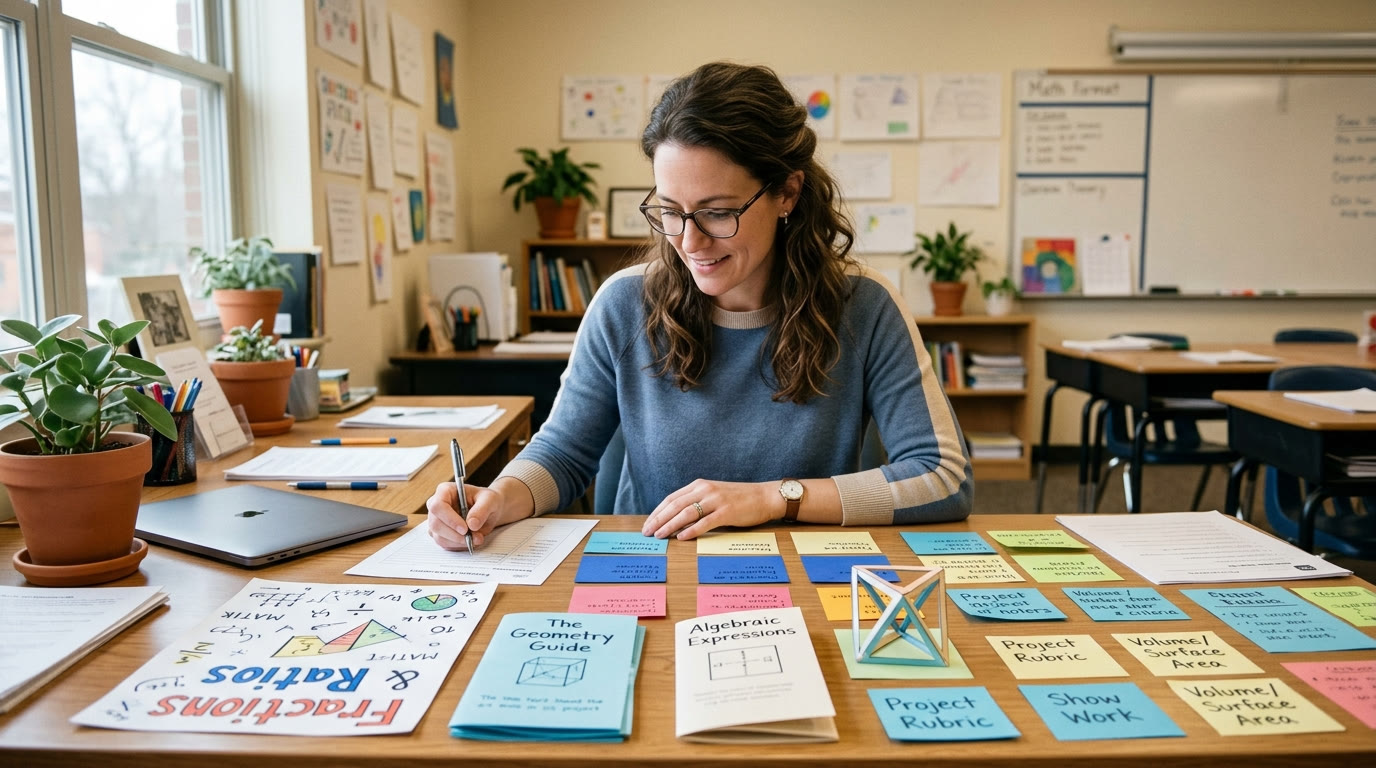
Certification portfolios, National Board especially, live and die by written reflection, and reflection is exactly the kind of writing most teachers freeze in front of. Not because they lack the practice to describe, they don't have the time to sit with a blank page and reconstruct what happened in a lesson from three months ago. That's the actual bottleneck, and it's the one place AI genuinely helps, if you use it for structure and not for substance.
What the process actually rewards
Every certification framework, National Board's component structure, most state license-renewal reflections, is scoring the same underlying thing: specific evidence connected to a specific claim about your practice. Not "I differentiate effectively," but a described moment, a student response, an adjustment you made, and why.
Where AI genuinely helps
- Getting past the blank page. Feed it your raw notes, a lesson description, a rubric excerpt, and ask for a structural outline: claim, evidence, analysis, so what. You fill in the real detail.
- Tightening rambling drafts. Paste a messy reflection and ask, "where is this vague, and where does it need a specific example instead of a general statement?" It's a good editor for structure and specificity gaps.
- Checking against the rubric language. "Does this reflection address [specific component language] directly, or does it talk around it?" is a genuinely useful gut-check before you submit.
Where it will actively hurt your portfolio
- Writing the reflection from a lesson description alone. It will produce something plausible-sounding and generic, and evaluators who read hundreds of these can tell. Specificity is the entire signal they're scoring.
- Inventing a moment or student response that didn't happen. Beyond being dishonest, it's usually detectable, real classroom moments have a texture generic writing doesn't.
- Skipping the analysis layer. A description of what happened isn't a reflection. "So what did this tell you about your practice, and what did you change next" is the part that actually scores, and it has to be yours.
A workflow that keeps you honest
1. Write your raw notes first, messy, bullet points, no polish. This is the only non-negotiable step.
2. Ask AI for a structure: where's the claim, where's the evidence, where's the gap.
3. Fill every gap with your own specific memory or student work sample, never a plausible invention.
4. Ask it to check tightness and rubric alignment on the final draft, not to write the final draft.
Building the evidence bank before you need it
The biggest time-saver isn't a better prompt, it's not starting from zero. Keep a running folder all year, student work samples with names removed, a quick two-sentence note after any lesson that went unusually well or badly, an occasional video clip. When portfolio season arrives, you're organizing evidence you already collected instead of trying to remember a lesson from October in April. This single habit does more for portfolio quality than any amount of AI-assisted editing at the end.
A word on time management
Certification windows are long, and the temptation is to let the writing pile up until the deadline, then lean on AI to move faster under pressure. That's exactly when the shortcuts described above, invented specificity, skipped analysis, become tempting. Block small, regular sessions instead, even thirty minutes every other week, using the raw-notes-first workflow each time. The reflection you write calmly in November is almost always stronger than the one you rush in April.
Reflection writing is slow because it's supposed to make you actually think back through your practice, that's the point of the exercise, not a flaw in it. Our [PD plan generator](/pd-plan) can help structure the growth story around your certification goal for the rest of the year, but the reflection itself has to come from your own classroom.