A test result that doesn't match what you thought the class understood is a familiar kind of frustrating. Usually the instinct is to blame the students, or blame the review day. Often the real problem is upstream of both: the test itself doesn't actually match the time and weight you gave each topic in the unit.
What an assessment blueprint actually is
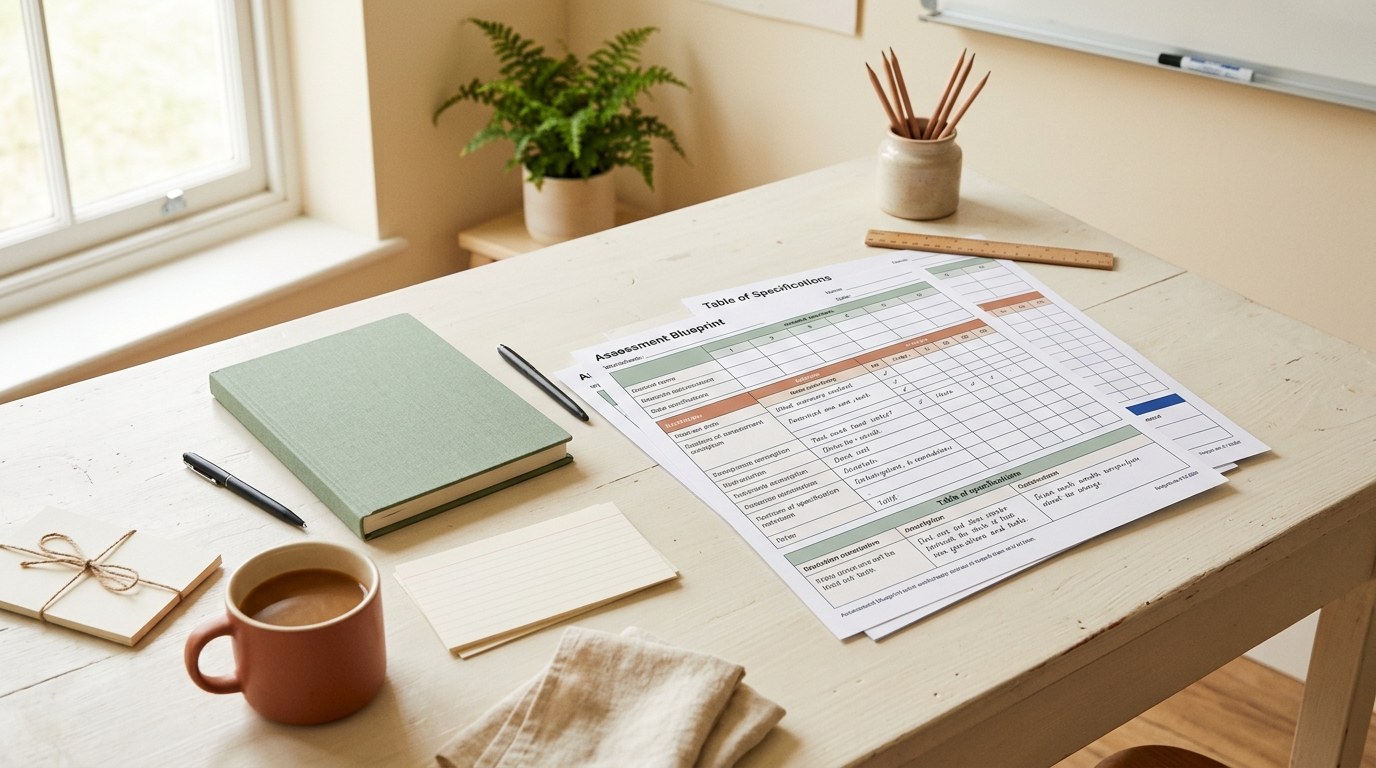
A blueprint, sometimes called a table of specifications, is just a grid mapping test questions to the standards or objectives they assess, and roughly how much class time or emphasis each one got. It sounds like paperwork. It's actually the fastest way to catch a test that's quietly unbalanced before you hand it out, not after you're grading it.
The mismatch that happens without one
Here's the pattern: a topic that took two days of class gets one question on the test, and a topic that took twenty minutes gets four questions, because four questions were easy to write and the two-day topic was harder to assess cleanly. The test ends up measuring what was convenient to write questions about, not what you actually spent the unit teaching.
The 20-minute fix
1. List your unit's actual topics and the class time each one got. Not what you intended to spend, what actually happened, if a topic ran long because of reteaching, it earned more weight, not less.
2. List every test question and which topic it maps to. This is the step that surfaces the imbalance, you'll often find one topic has zero questions and another has six.
3. Compare the two lists side by side. Time spent should roughly track with points on the assessment. A topic that was 30% of instructional time shouldn't be 5% of the test, or 50% of it.
4. Adjust the outliers, not the whole test. You're not rewriting the assessment, you're moving one or two questions from an over-represented topic to an under-represented one, or writing one new question to cover a gap.
5. Check cognitive level too, not just topic coverage. If every question is recall-level and you spent the unit on application and analysis, the blueprint check catches that mismatch as well, not just topic weighting.
What this catches that review sessions don't
Review sessions catch content students are shaky on. A blueprint catches content the test itself is shaky on, gaps and overweighting that exist regardless of how well the class studied. It's a check on you, not on them, and it's the reason a class that seemed to understand a topic can still bomb a section of a test that barely asked about it.
Where a first draft helps
Building a blueprint from scratch after a test is already written means going backward through every question by hand. Our [assessment blueprint tool](/assessment-blueprint) generates the topic-to-question mapping directly from your unit's standards and instructional time, before you finalize the test, so the imbalance shows up while it's still a 20-minute fix instead of a confusing set of results you have to explain after the fact.