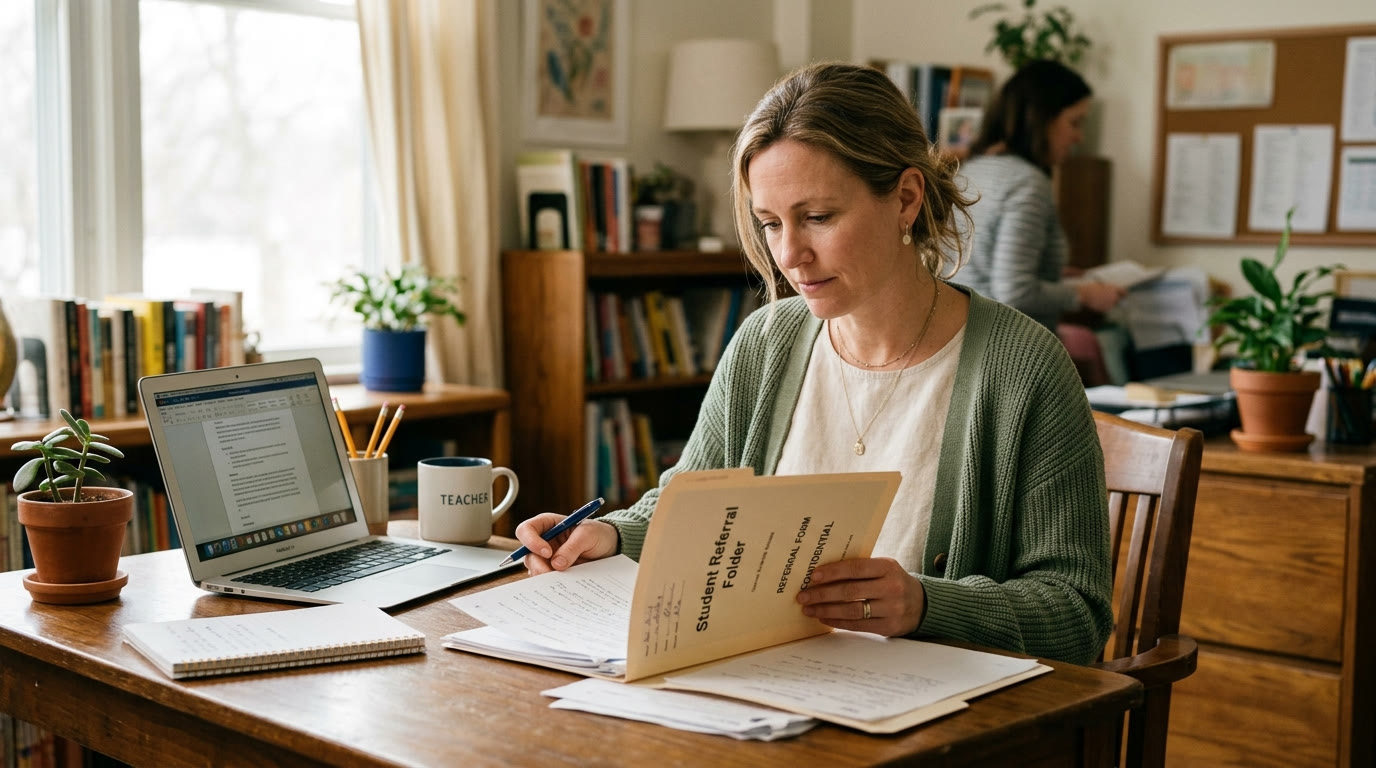
You've got a kid who finishes the unit test in twelve minutes, then spends the rest of the period doodling complex mechanical drawings in the margins of their notebook. You know they need something more. So you write the referral: "Student shows advanced ability and would benefit from gifted services." Then it sits in a folder for six weeks, because the committee can't act on a sentence like that.
A referral that moves is one that hands the committee evidence instead of an impression.
What stalls a referral
Committees aren't slow because they don't care. They're slow because a vague referral creates work for them - someone has to go find the evidence you didn't include, or send it back asking for more detail, and both of those add weeks. The referrals that move fast already contain what the committee would otherwise have to go dig up themselves.
What actually stalls:
- "Shows advanced ability" with no specific example attached
- One data point (a single high test score) with no classroom behavior to back it up
- No comparison to grade-level expectations, just "does well"
- Missing the piece parents or a specialist teacher would need to weigh in
Build the referral around three kinds of evidence, not one
A referral that reads like a real case has three legs, and most incomplete ones are missing at least two:
1. Quantitative evidence. A test score, a reading level, a math placement assessment - a number the committee can check against their local threshold without asking you for it later.
2. Classroom evidence. A specific, dated example: "On March 3rd, finished the assigned fraction unit in one class period and independently extended it to mixed-number division without prompting." Not "is ahead in math" - the actual thing that happened.
3. Pattern evidence. One example is a data point; three examples across different units or subjects is a pattern the committee can act on with confidence.
Use AI to turn your scattered notes into the case, not to invent the evidence
The evidence has to be real - a committee that gets a generic-sounding paragraph will ask questions, and you don't want to be defending claims you can't back up. What AI is actually good for here is organizing what you already have into the structure a committee expects, so you're not starting the write-up from a blank referral form the week it's due.
Try this:
- "Here are my dated observation notes on a student for the last two months: [paste your notes]. Organize these into a gifted referral: a summary paragraph, then the quantitative, classroom, and pattern evidence sections separately, in the tone a committee expects."
- Read the draft against your actual notes line by line. Cut anything the model added that you didn't actually observe - this is the one place embellishment costs you credibility with the committee, not just makes the writing weaker.
What to attach, not just describe
- The actual test or assessment printout, not a paraphrase of the score
- A work sample if you have one, the extended fraction work, the essay that went two grade levels beyond the assignment
- Any specialist input already on file (reading interventionist, math coach) rather than asking the committee to go request it
Where our tool fits
Our [gifted and talented plan generator](/gifted-plan) can help you turn a confirmed identification into an actual services plan once the referral clears committee - the enrichment structure, the pacing, the extension tasks that make identification mean something day to day instead of a folder entry. Pair the referral itself with our [parent communication generator](/parent-communication) when you need to loop a family in on the process without either overselling what identification guarantees or underselling what you've observed.
A referral that moves the first time isn't the one with the most enthusiastic language. It's the one where the committee doesn't have to ask you a single follow-up question before they can act.